
The promise of health care reform in Vermont is fueled by years of grassroots support and support from various stakeholders, ranging from physicians to state politicians. With the passage of Vermont’s Health Care Reform Legislation, Act 48 (H.R. 202), and the implementation of these regulations in conjunction with the Patient Protection and Affordable Care Act, the promise of health care reform will become a reality. The current health care system in the state of Vermont consists of a public-private partnership. This partnership provides private health insurance, a fee-for-service for provider services reimbursed by managed care organizations, supplemented by public health insurance options.
The new health care system will resemble a single-payer health care system where the processing of insurance claims and the payments to providers are done simultaneously through a simplified administrative system from a single funding source. The funding sources will be supplemented by Medicare and Medicaid funds, state appropriations, grants, donations, and other revenue sources [1]. As a result of the new health care system, the attainment of health insurance will not be linked to employment, making it more accessible.

Figure 1. Schematic of Single-Payer Health Care System
The difficulties of the current system that are to be corrected by the new system are the number of Vermonters that are uninsured or underinsured and the rising cost of health care. In recent years, the cost of health care in Vermont has increased by an annual rate of 8 percent, 3 percent higher than the national rate [2]. Before the implementation of this system, several requirements need to be met under the Affordable Care Act. One such requirement is the establishment of a Health Benefit Exchange so to provide affordable health care. The Health Benefit Exchange will facilitate the change of the current health care system from a fee-for-service paradigm to a single-payer, universal coverage paradigm. The Health Benefit Exchange will become operational for single families in 2014.
In 2017, the state will apply for a federal waiver with the hope of eliminating federal regulations under the Affordable Care Act. After receipt of the federal waiver, the implementation of the single-payer health care system will commence. Once full implementation takes effect, health care coverage will be administered through Green Mountain Health Care, a publicly funded health insurance plan designed to provide universal health care coverage. In the interim, residents of Vermont will rely on Vermont’s Health Benefit Exchange to either gain access to health insurance at a low cost or supplement their health insurance needs outside of their employer-based coverage. Accordingly, when the single-payer health care system becomes operational, the residents of Vermont will have comprehensive universal health care coverage based solely on their residency. According to Act 48 (H.R. 202), a financing plan by Vermont’s Agency of Administration is required to outline the financing mechanisms of the Health Benefit Exchange. The Legislature of Vermont subsequently will vote on the proposed financing plan. The Health Care Reform Financing Plan per Act 48 1(a) intends:
“to contain costs and to provide, as a public good, comprehensive, affordable, high-quality, publicly financed health care coverage for all Vermont residents in a seamless manner regardless of income, assets, health status, or availability of other health coverage [3].”
Earlier this year, a financing plan was submitted to the Vermont Legislature and approved with the compromise of eliminating a tax on annual premiums for enrollees in the Health Benefit Exchange marketplace for the extension of a tax on employers. The state of Vermont has already received a federal grant of $18 million to finance the marketplace. With the financing plan in place, the Legislature of Vermont will begin to make necessary changes in the state budget to appropriate the funds needed to supplement the marketplace. The chart below denotes the state funds needed to subsidize the Health Benefit Exchange marketplace from the fiscal year 2015 to the fiscal year 2017.
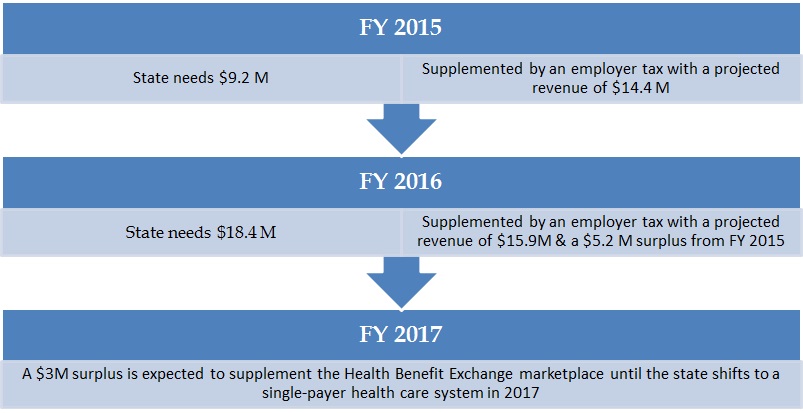
Figure 2. State funds needed to finance the Health Benefit Exchange [4]
As noted in Act 48 (H.R. 202), Vermont’s new health care system must be” evaluated regularly for improvements in access, quality, and cost containment [5].” Policy initiatives that identify those most in need of health insurance and encourage enrollment in Vermont’s publicly financed health care system will have an impact in reducing the number of uninsured in the state. The Affordable Care Act requires states to develop an outreach and education program to ensure residents are aware of the health insurance options available under the law. This policy will mesh well with the steps the state of Vermont needs to take to inform its residents of the new health care system and reach out to residents to facilitate enrollment. After full implementation of the single-payer system, policy measures should focus on fine-tuning administrative mechanisms that are cost-effective and ensure efficiency. It may take years before one can appreciate the full benefit of the single-payer system or assess any strain this system may have on the state. Yet, there are indicators that restructuring the health care system to provide more residents with access to care will have a lasting positive effect on the health outcomes of those uninsured and or underinsured.
[1] Agency of Administration (n.d.) Vermont’s Health Care Reform. Retrieved from http://hcr.vermont.gov/.
[2] Hsiao, William C. Kappel Steven, & Gruber, Jonathan. Act 128: Health System Reform Design. Achieving Affordable Universal Health Care in Vermont. February 2012.
[3] Agency of Administration (n.d.) Vermont’s Health Care Reform, Act 48 one-age summary. Retrieved from http://hcr.vermont.gov/.
[4] Stein, A. Legislature approves exchange financing plan and health care bill reform. Retrieved from http://www.vermontbiz.com/news/may/legislature-approves-exchange-financing-plan-and-health-care-reform-bill.
[5] Vermont Health Reform Law. Act 48 (H.R. 202), 2011.
