
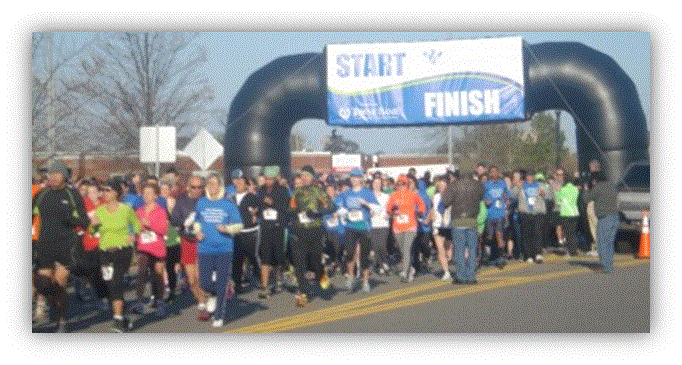
Bons Secours 5k for Colon Cancer and 1-Mile Fun Walk (Suffolk, VA)
Introduction
On April 6, 2013, Bon Secours Hampton Roads hosted their 3rd annual 5k for Colon Cancer 1-mile fun walk to promote colon cancer awareness and raise money to provide patient care through the Bon Secours Foundation. The health message from this event, “Don Get Left Behind,” reinforces the importance of being educated about the risks of colon cancer and the benefits of screening. Colorectal cancer is a preventable disease; however, it remains the 2nd leading cause of cancer-related death in the United States [1]. Healthy People 2020, implemented through the Office of Disease Prevention and Promotion, set a goal of “reducing the number of new cancer cases, as well as the illness, disability, and death caused by cancer.” There is also a specific health objective to reduce the colorectal cancer death rate to 14.5 deaths per 100,000 people per year[3]. Reductions in colorectal cancer morbidity and mortality rates are obtained through early detection and treatment and the identification and removal of adenomatous polyps, the precursors of colorectal cancer.
Evidence suggests a low level of awareness about the risks of colorectal cancer that presents a public health issue. As a result, screening guidelines have been implemented for adults aged 50 years or older. Screening is the process of detecting disease at an early and usually asymptomatic stage in a population considered at risk. The United States Preventative Services Task Force (USPSTF) recommends that adults 50 years of age and older should receive regular screening by either a (1) a fecal occult blood test (FOBT) once a year, (2) a flexible sigmoidoscopy once every five years, (3) a colon examination by colonoscopy every ten years or by (4) a double-contrast barium enema every 5-10 years, until the age of 75. Screening should be personalized. Continuing to offer colorectal cancer screening into advanced age when the patient is unhealthy or facing a terminal illness would prove inefficient. Thus the appropriate age to stop screening for a particular disease is dependent on the judgment of the individual and their physician.
Lack of Compliance of the Colorectal Screening Guidelines
Despite the colorectal screening recommendations by the USPSTF and the fact that Medicare covers screening for persons 50 years of age or older, there has been a slow rate of colorectal screening adherence in the United States [4]. In a recent study, 36.6% of US adults aged 50-59 reported never having been screened for colorectal cancer [5]. Data shows the screening rates are lower among individuals who live in rural areas than individuals who live in urban areas. There is a higher percentage of compliance among individuals who live in the Northeast than in any other region in the United States. Individual adherence to the recommended screening guidelines could have prevented as many as 60% of deaths from colorectal cancer [6]. This number reflects suboptimal compliance among the targeted screening population. A study by Beeker et. al. revealed attitudes toward specific screening tests were varied but generally negative. The most common reasons include a lack of awareness of colorectal cancer, the failure to appreciate the concept of asymptomatic illness, and the unpleasantness of the screening procedures. Health care providers have been identified as the most important source of influence for patients getting screened. Evidence shows a direct positive correlation between that of a physician’s recommendation to that of patient compliance. This fact raises an issue of whether recommending the colorectal cancer screening guidelines is common practice among health care providers. A review of the literature shows there are several perceived barriers to recommending the screening guidelines. The most common perceived barriers identified include a lack of time, a lack of personnel, and no reminder system. In a recent study, physicians with electronic medical records, compared to those with paper charts, were more likely to adhere to guideline-consistent screening recommendations.
To promote awareness about colorectal cancer screening guidelines the Centers for Disease Control initiated a public health campaign, Screen for Life, highlighting the benefits of colorectal screening. The public health campaign is quite extensive. The campaign includes radio and television public service announcements aimed at increasing awareness about the importance of colorectal cancer screening and influencing men and women 50 years of age and older to take the initiative to get screened. As a means of emphasizing the importance of screening, §2713 of The Patient Protection and Affordable Care Act has a provision that requires new health insurance plans to cover the recommended colorectal cancer screening procedures. As of 2010, the insured of any health insurance plan is not required to make any out-of-pocket payment to receive a fecal occult blood test, sigmoidoscopy, or colonoscopy.
Conclusion
Events like the one featured here educate individuals about the benefits of colorectal cancer screening and empower them with the information needed to get screened. The screening guidelines recommended by the USPSTF are primarily used as a means of prevention, not as a requirement of care. Nevertheless, any benefit highlighted as a product of getting screened should be an incentive. Policy development emphasizing a physician’s adherence to recommending colorectal screening guidelines would increase screening among those most at risk, having a dramatic effect on the reduction of new cases of colorectal cancer.
[1] U.S. Cancer Statistics Working Group. United States Cancer Statistics: 1999-2008 Incidence and Mortality Web-based Report. Atlanta: U.S. Department of Health and Human Services, Centers for Disease Control and Prevention and National Cancer Institute; 2012. Available at: www.cdc.gov/uscs.
[2] United States Department of Health & Human Services, Healthy People 2020 (2011, June 29). Cancer: Overview. Available at: http://www.healthypeople.gov/2020/topicsobectives2020/overview.sapx?ttopicId=5.
[3] Ibid.
[4] Witlock, Evelyn P., Lin, Jennifer S., Liles, Elizabeth, & et. al. (2008). Screening for Colorectal Cancer: A Targeted, Updated Systematic Review for the U.S. Preventive Services Task Force. Ann Intern Med.,149(9).
[5] Stanley, Sandte L., King,, Jessica B., Thomas, Cheryll C., & Richardson, Lisa C.(2013). Factors Associated with Never Being Screened for Colorectal Cancer. J Community Health, 38.
[6] Yarboff, Robin K., Zapka, Jane, Carrie N. Klabunde, et.al. (2011). Systems Strategies to Support Cancer Screening in U.S. Primary Care Practice. Cancer Epidemiol Biomarkers Prev., 20.
